Monday, May 9, 2016

Weather!


It’s a weather day up here on the Greenland Ice Sheet – winds blowing 25-45 mph and snow attempting to completely bury our tents if we stop digging them out, which is no small task with a large kitchen tent, science tent, poop tent, and five personal sleep tents. We spent most of yesterday afternoon tiding up camp so that we wouldn’t lose science equipment or, god forbid, our 50 lb. box of candy and hot chocolate underneath the snow. Amidst the blinding blizzard we packed a few sleds with ice coring equipment, extra fuel, and food for our next camp so that it wouldn’t blow away (as we were communicating with each other via a combination of sign language and muffled grunting, no small task while wearing mittens, balaclavas, goggles, Carhartt overalls, heavy boots, gigantic jackets, and numerous base layers). Thomas cooked a delicious dinner with rice, lentils, beans, and reindeer meat (which really tastes like Christmas!) and we celebrated the end of our first successful week on the ice sheet. We secured our tents with large bamboo stakes and parachute cord before crawling into them for a blissful night listening to the howling wind and snow.
The team assembled, ready to fly to Raven.
This morning Erich made us pancakes (and Tate cooked up a few of his special Butterfinger pancakes) with real Vermont maple syrup and a side of bacon. We sipped a few cups of coffee and listened to the BBC on our antiquated high frequency radio. Even high up on the Greenland Ice Sheet, 1000 miles from the nearest shower, we can’t escape hearing Donald Trump’s voice on the radio. Yay. We’re all spending the rest of the day backing up and analyzing science data, calling our moms (happy Mother’s Day!) and significant others, and reading/relaxing in our tents. Not a bad way to wait out the blizzard. If we can find the box of baby wipes buried in one of our boxes under the snow I might even get to “shower”, I’m sure everyone else would thank me after a week in the same pair of socks and underwear. No one wants to change underwear when it’s -30 degrees at night, despite the smell.
Erich drilling with the SideWinder system.
We’ve had a successful few days of science since our last blog post. Erich, Thomas, and Gabe drilled a 30 meter ice core (in 30-50 cm intervals) to analyze snow accumulation over the past few decades, Tate and Forrest performed a few radar surveys around camp, and a few of us alternated surveying 30 km east and 60 km west of camp with various pieces of not-yet-broken science equipment. Gabe took a few snow samples and measured albedo at the ends of both spurs, Thomas flew a kite with a camera to measure surface roughness around camp and got beautiful aerial photos of us, Tate fixed the stubborn 500 MHz radar, and Erich got near infrared photos of the ice core as we were collecting it.  During our drive back to camp yesterday we were in a complete whiteout (maybe 100 ft. visibility, at best) barreling across a desolate white ice sheet at 30 mph with very expensive equipment in tow. It’s a bit daunting to rely completely on the GPS to guide us back to camp, since there was no hope of retracing our tracks once the wind picked up, and even more jolting to hit large sastrugi without being able to see them coming.
Setting up radar on the sleds.
Hopefully we can use this storm as an opportunity to organize our food boxes, fix the broken downward looking laser and various cables that have snapped in the cold, and finally finish reading Cadillac Desert – which has put me to sleep every night this week. The storm is supposed to persist all day tomorrow but hopefully by Thursday morning we’ll be moving towards Camp 2 and collecting more data.
Sending our best from the middle of Greenland,
The GreenTrACS Team


Aerial view of camp, acquired with Thomas' kite-cam.


Friday, May 6, 2016

Update from the field team with Pics!

Bob here, posting text and photos from Gabe via iridium:

Greetings from the Greenland Ice Sheet! I'm writing this from inside an Arctic Oven tent on an internet connection that has about the same speed as a circa 1985 Macintosh computer - aka not very fast. We can only upload incredibly small image file sizes so sorry about the quality, but it's working!

Everything is going well up on the ice sheet. We spent three nights at Raven/Dye 2 where we were dropped off by a large plane with all our equipment. We had several rounds of testing equipment and trying to optimize data collection while we could still have equipment flown in on the Air National Guard training flights. We ended up spending lots of time setting up the different radar systems and testing them on the ice (which was very different than testing everything out in Idaho).

On the third day, Erich, Forrest, and Gabe drove four 55-gallon drums of fuel and all the ice core equipment to the location of the first core (about 30 km north of Raven/Dye 2). Although we were driving slower than your grandmother, all the wind blown bumps of snow on the surface (called Sastrugi) bounced the sleds around so much that we punctured small holes in 3 of the 4 fuel barrels, nothing a little bubble gum and precarious perching of the barrels at camp couldn't fix. These same Sastrugi were responsible for the death of the downward looking laser system (sorry Bob!) and we accidentally plugged the first FMCW (frequency modulated continuous wave) radar into the battery the wrong way - oops.

We finally drove everything to the first core site (at a whopping 5 mph so that the radar can collect quality data) over two days while Erich and Gabe set up the kitchen and science Arctic Oven tents, the personal sleep tents, and started digging a 4 ft snow pit to do some science. Gabe collected albedo (how bright/shiny the snow is) measurements, Tate has mastered the 500 MHz multi-offset radar system and Frequency Modulated Continuous Waveform (big scary science words!), Thomas is back in Greenland for another round with the GSSI radar, Erich has happily collected the first 20 m of his ice core here at Core 1, and Forrest is happy to listen to the British Brodcasting New Zealand on his High Frequency radio while he's falling to sleep.

Temperatures have been fluctuating between -30 and -15 C (which is pretty darn cold when you're sleeping in a tent) so everything is pretty slow going with multiple layers of gloves, jackets, Carhartt pants and our endless supply of toe warmers.

That's all for now! Hoping to check back in this weekend while we're all sitting inside the tents as a big storm blows through.

- The GreenTrACS Team


Forrest setting up a radar system in front of the personal tents


Thomas staring off into the sunset at 11 pm after a long day of radar


Forrest practicing his refueling skills while Erich dances to some music


The C-130 plane after dropping us off at Raven/Dye 2 (an old missle tracking system to stop the Russians from bombing us) in the background

Quick update- Science progress!

Hi All--
  A few quick science updates from Erich in the field:

They has a great day yesterday, drilling to 20 meters smoothly, and running radar out to 30 km to the east of camp 1.  They also ran the FMCW and multi-offset radars in a pattern around the core site, to characterize the site.  At the farthest point east, they measured albedo and density in a shallow pit, and returned following a Operation IceBridge flight line (different from the one they followed on the way out).

Today, they plan to deepen the core to 30 meters, and run all of the radars to the west (as I type I see they are close to 30 km to the west). 

Erich's closing message sums up how the team feels a few days into the traverse, having worked out some of the kinks of traveling with thousands of pounds of gear and trying to collect data with delicate instruments:
 "Feel like we have our feet under us."

Well said.   Stay tuned- keep an eye on the breadcrumb trackers to watch where our team goes!


Monday, May 2, 2016

2 May 2016- second day on ice!

Just off the satellite phone with Erich from Raven, where the team was inserted with a LC-130 Hercules Saturday.  After setting up a temporary camp, part of the team took a shakedown run up to the first core site yesterday, getting a feel for the conditions and how the sleds pulled.  They brought about 3/4 of the cargo to the first core site, and then returned to Raven.  All in all a good shakedown. 

Still getting instruments up and running, but Erich reported the laser surface profiler and GPS units are working, and configuration of the radars are underway. 

All are in good spirits and ready to head to core site 1 tomorrow!  Stay tuned to the breadcrumb tracker to watch their progress. 

Friday, April 29, 2016

April 25-29: Preparations in Kangerlussuaq, Greenland


Early morning last Monday we woke up in Scotia, NY and drove to the 109th Air National Guard for our flight to Kangerlussuaq. We had all our gear and food loaded in air force pallets in the back of C-130 airplanes while we were crammed into the waiting room before the flight. After a few maintenance delays (it's not United Airlines but there are still delays) we were able to load onto the plane and squish in-between the cargo. Everyone managed to nap and relax during the 3 hour flight to Goose Bay, Canada, where we quickly refueled the plane and took off for the remaining 3 hour flight to Greenland. There are very few windows on the C-130 and the temperature seemed to fluctuate between wishing we were able to crawl into a sleeping bag and wishing we were wearing shorts.


Inside the plane all the pipes, wires, and metal was exposed so that the Air National Guard could inspect everything before and during the flight. It was a bit eerie to be able to see all the working parts of the plane, with loose pieces of insulation dangling off the ceiling and wires that appeared to date from the 1970's.


Tate and Erich alternate between sleeping and working inside the C-130

A C-130 sits on the runway in Kangerlussuaq below a large rocky hill slope

We landed in Kangerlussuaq and were greeted by our logistics friends at with Polar Field Services, who drove us to the Kangerlussuaq International Science Support (KISS) building for some warm pizza and our beds to sleep in. We met many other scientists and logistics support personnel coming to and from Greenland to conduct research and keep the research operations humming. Lots of new friends!

We spent the next several days organizing and testing all our gear before loading it onto a different plane to send to the ice sheet. We set up our kitchen and science Arctic Oven tents as well as our personal sleep tents, tested the kitchen stove and emergency back-up Whisperlite stoves, had a lesson from the snowmobile mechanics on how to properly drive and fix the machines, and even got out to test our rifles in case a hungry polar bear tries to get too close. We spent several hours figuring out a mounting system for a downward mounted laser to measure surface roughness, and some of the CPS mechanics were able to build a snow density cutter for us on short notice since one of ours was accidentally left behind in Boise, Idaho.  Everyone with CPS here in Kanger has been working hard to help us have a successful and safe expedition. Thank you everyone!!

The group admiring our gear upon arriving at the warehouse in Kangerlussuaq

Thomas setting up his personal Trango tent to make sure we have all the parts.
Communal kitchen tent is yellow in the background
Erich modeling our snowmobile helmets
Carpenter Erich cutting wood to fit under the tables in the kitchen tent.
Tate admiring his new snow density cutter made with scraps in Kangerlussuaq

Erich ponders the structural stability of our surface roughness laser attached to the Nansen sled

In total, we have 1000 lbs of food and roughly 3000 lbs of science and support gear. We'll be towing four 55 gallon drums of gasoline (another 1750 lbs) with us from the start and each cache site and will be collecting ice cores along the way that we'll have to keep transporting to the next cache location. 

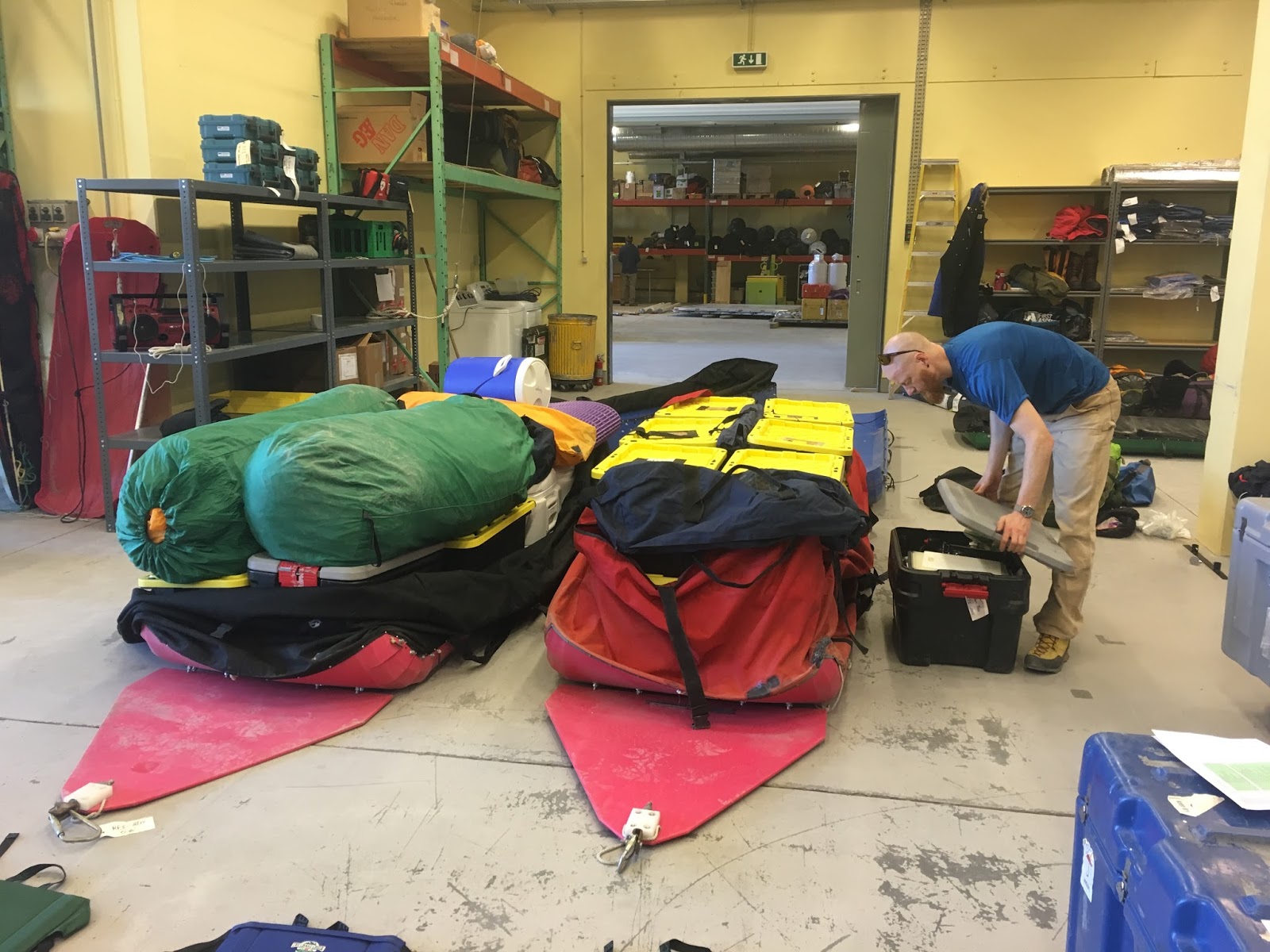
We have five snowmobiles and we figure each machine can tow ~1500 lbs, so our we're bringing about as much gear as possible for these machines. We started to load everything into plastic Siglin sleds and tried to divided the sleds so that they were loaded with approximately equal weights and sized boxes. Most of the sleds come with built in covers to keep drifting snow out of the gear, but we'll have to be careful to keep everything covered when storms start dumping snow on us.

Next, we unloaded all the sleds and reloaded everything onto large air force pallets for the Air National Guard to fly us up to our first camp, called Raven or Dye-2, nearly 200 km (125 miles) onto the ice sheet from Kangerlussuaq. When we get to Raven we'll have to unload the pallets and figure out how we want to distribute all the gear for traversing across the Greenland Ice Sheet.


Thomas loading the final box of gear onto a snowmobile.
Food boxes are in yellow and the large communal tents are green.


Some of us even had enough time to visit the edge of the ice sheet with Rebecca Finger and Melissa DeSiervo (Dartmouth ecologists monitoring Arctic flora and fauna) and spend a night at their camp. Point 660 is the end of the longest road in Greenland and provided some spectacular views of the ice sheet, plus we got to see four arctic hares and several herds of caribou on our drive out there.


A view of the ice sheet from the end of the road - Point 660.
Wow that's a lot of ice!

Camping near the edge of the ice sheet with the Dartmouth Ecologists

Sunday, April 24, 2016

April 24: Joint Expedition to Measure Historic Snowfall in Greenland

Original story by Becca Burke at Boise State University

Tate starting to snowmobile in Idaho
While some on the Boise State campus are preparing for hot summer days and barbecues, graduate student Tate Meehan is preparing for frigid temperatures and hard work. 

Meehan, who is in the first year of his master’s program in geophysics, is headed to a research expedition on Greenland. He’ll be joined by Forrest McCarthy, a mountaineering guide from the Wilderness Wildland Alliance and National Science Foundation Polar Programs, Dartmouth polar geoscientist Erich Osterberg, and Dartmouth doctoral students Gabe Lewis and Thomas Overly. 

The combined Boise State and Dartmouth research team will study and measure snowfall amounts over the past 50 years in an area that contains some of the largest snowfall variances on the Greenland ice sheet. This expedition comes at a precarious time; in recent weeks Greenland’s early melting season, brought on by unseasonably warm weather, has some global researchers concerned.

“This trip is especially critical this year as Greenland has experienced the warmest first four months on average in its recorded history, which dates back to the 1870s. It’s the onset of melting that has happened about two months ahead of schedule that makes our job a lot more challenging,” Meehan said. 


The view from our test site in Idaho
The research team begins their expedition in Greenland at the NSF deep field station Camp Raven in southwest Greenland and will travel 1,700 kilometers from Southwest Greenland to the summit of the ice cap. The team will use a variety of Boise State radar systems to track the subsurface snow layers, and will continuously measure the journey to the summit. The age of the layers will then be determined by a geochemistry analysis of 60-foot core sample sections of ice and snow. The research data gathered from each sample site allows for estimation on annual snowfall amounts dating back over 50 years. 

During the seven-week expedition, the research team will travel by snowmobile and live in tents. In addition to mapping new areas for measurement, they will also revisit multiple Program for Artic Regional Climate Assessment (PARCA) sites. PARCA was launched by NASA in 1993 with the primary goal of measuring and understanding the mass balance of the Greenland ice sheet.
Towing radar equipment with a snowmobile
The Greenland field expedition is funded by a collaborative NSF Office of Polar Programs grant between Boise State and Dartmouth. The principal investigators from Boise State are geoscientists H.P. Marshall and John Bradford, and for Dartmouth, they are Osterberg and Bob Hawley. This trip to Greenland will include detailed core sample analysis and radar observations completing half the full traverse; a second trip will be completed next year. 

This research continues previous work in Greenland conducted by Marshall and Bradford. Bradford’s radar inversion work completed with Boise State doctorate student Joel Brown and University of Montana glaciologist Joel Harper will be applied to the radar data collected during this research trip. Marshall conducted radar measurements in 2010 and built a radar system used for a traverse from the summit to Thule Air Base. 

The research being conducted during this trip and the subsequent trip next year holds significant relevance for the future of the planet and research into climate change. 

“This project is important, because we don’t know much about the snowfall amounts in this area,” Marshall explained. “The snowfall in this area is changing and controls the behavior of a large part of the ice sheet. The behavior of the ice sheet is important because it is the major contribution to global sea level rise, and affects global climate.”

Thursday, April 14, 2016

April 12: Food and Gear Packing!

While Thomas and Gabe were out in Idaho testing the radar equipment, Erich and Karina purchased 1000 lbs of food to prepare for the traverse. While snowmobiling across Greenland, we cannot have any food with us that spoil during the 6-7 weeks, which limits our selection to pretty much just instant oatmeal and Snickers bars. We all spent most of last week packaging and sorting the food into freezer Ziploc bags that will still work with gloves in the cold.

1000 lbs of food before sorting and packing
We had several undergraduates in Erich and Bob's research groups help with the food packing, which allowed the rest of us to pack the 1600 lbs of research gear into various cases. We were able to pack a few boxes of food (mostly candy) that will be dropped at a fuel cache site halfway through our traverse. This will allow us to carry less weight and will re-energize us when we find several boxes of York Peppermint Patties in the middle of the ice sheet.
Scotty helping pack some delicious soup into a Ziploc

We finished packing a total of 2600 lbs of food and gear late Sunday night before dropping it off at the Air National Guard in Scotia, New York, who will fly it to the start of our traverse in Greenland next week.  We even had some spare time to let a five-year old try on some of our equipment. Hope it fits us better that it fit him!


A five-year old child tries on a jacket during the recent Dartmouth Science Day outreach program